
A carrier safety audit is a mandatory FMCSA review that verifies a motor carrier has adequate safety management controls and complies with Federal Motor Carrier Safety Regulations (FMCSRs) to ensure safe operation. More specifically, the formal term is the New Entrant Safety Audit, part of the FMCSA's New Entrant Safety Assurance Program. Every new motor carrier operating in interstate commerce faces this review within the first year of receiving operating authority. The audit is pass/fail with no fines assessed during the process itself, which means it is a compliance checkpoint, not a penalty event.
What is a carrier safety audit and when does it happen?
The New Entrant Safety Audit is defined as a structured review of a carrier's safety management systems, documentation, and regulatory compliance. The audit gathers critical safety data to assess whether a carrier's safety performance controls are functioning effectively. No safety rating is issued at this stage. The FMCSA uses the results to determine whether a carrier is fit to continue operating.
Timing depends on your carrier type. Property carriers face a 12-month deadline from the date they receive their USDOT number. Passenger carriers and hazardous materials (hazmat) carriers must complete the audit within 6 months. These deadlines are firm. Missing them puts your operating authority at risk.

The audit itself is typically conducted during business hours, Monday through Friday, at your principal place of business. That means the investigator comes to you, not the other way around. In some cases, the audit may be conducted remotely via document uploads, but you must still respond quickly to every documentation request. Remote or in-person, the auditor verifies that your actual operations match what you have reported and documented.
How long does the audit take?
Audit length varies by fleet size and document readiness. A small fleet with clean, organized records can complete the review in a single business day. A carrier with scattered files or missing documents may face follow-up requests that extend the process by days or weeks. Preparation is the single biggest factor in how smoothly the audit runs.
Pro Tip: Assign one knowledgeable staff member as the point of contact for the auditor. That person should know where every document lives and be available for the full duration of the audit.
- Confirm your audit date and time as soon as you receive the scheduling notice.
- Designate a staff contact who understands your compliance records.
- Prepare a dedicated workspace with all required documents organized and accessible.
- Brief your drivers on what the auditor may ask about hours of service and vehicle inspections.
- Do not treat the audit as a surprise. Plan for it from day one of operations.
Why are carrier safety audits important for small trucking companies?
The audit is not designed to shut you down. The FMCSA built the New Entrant Safety Assurance Program to provide educational and technical assistance to new carriers on FMCSRs and Hazardous Materials Regulations (HMRs). Think of it as a structured onboarding into federal compliance, not an ambush.
That educational purpose matters for small fleets. Many owner-operators and small fleet managers come from driving backgrounds, not compliance backgrounds. The audit creates a formal moment to identify gaps before they become costly violations. An investigator who finds a missing document during an audit is far less damaging than a roadside inspector who finds the same gap during a traffic stop.
"The audit is designed to support carriers, not solely to penalize them. Carriers should view the investigator as a resource to clarify requirements and improve compliance." — FMCSA New Entrant Safety Assurance Program
Passing the audit is also a business requirement. Failing can lead to loss of operating authority, mandatory corrective action plans, and costly delays to your operations. For a small carrier running on tight margins, losing operating authority for even two weeks can be financially devastating. The benefits of passing go beyond compliance:
- You retain your USDOT registration and operating authority without interruption.
- You establish a documented safety culture from the start, which protects you in future compliance reviews.
- You identify documentation gaps early, before they compound into systemic problems.
- You build credibility with shippers and brokers who increasingly check carrier safety records before awarding loads.
- You reduce the risk of costly roadside violations tied to the same records the auditor reviews.
What does a typical carrier safety audit checklist include?
The auditor reviews specific categories of records and systems. Knowing what is on the carrier safety audit checklist lets you prepare without guessing. The typical audit documents reviewed include driver qualification files, vehicle maintenance records, drug and alcohol testing documentation, and hours of service logs.
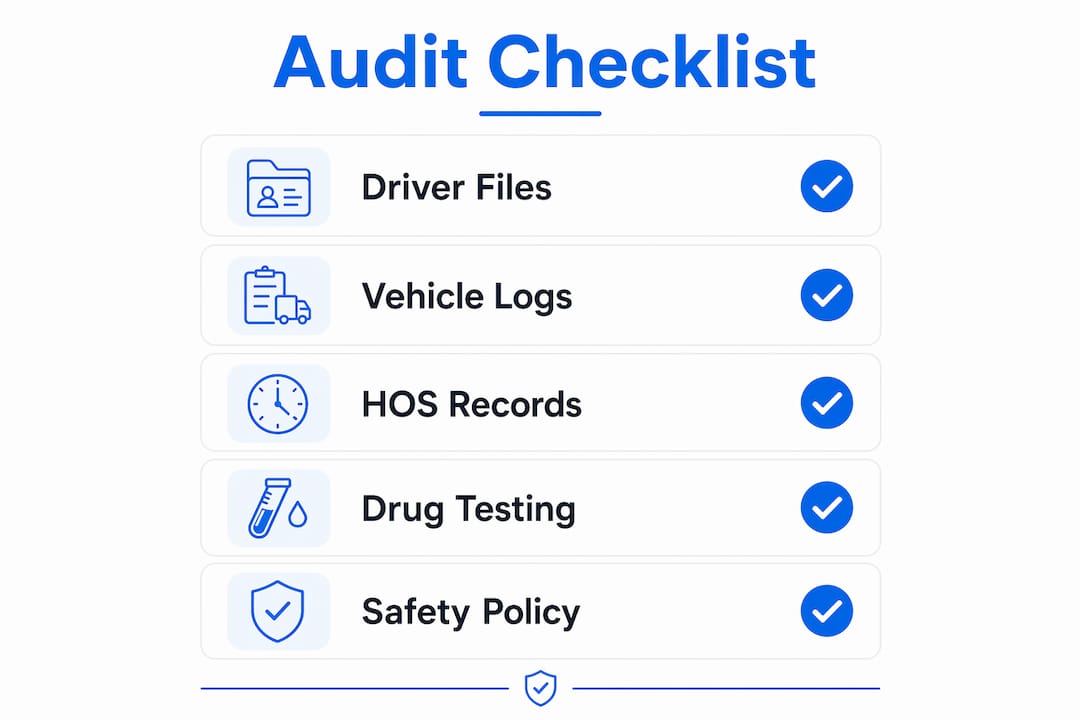
| Audit category | What the auditor checks |
|---|---|
| Driver qualification files | Valid Commercial Driver's Licenses (CDLs), medical certificates, driving history, employment applications |
| Vehicle maintenance records | Daily inspection reports, annual DOT inspections, repair logs |
| Hours of service records | Driver logs, Electronic Logging Device (ELD) data if applicable, supporting documents |
| Drug and alcohol testing | Written policy, pre-employment test records, random testing program enrollment |
| Safety management controls | Accident register, regulatory reporting, driver training documentation |
Each category carries weight. A missing CDL copy or an expired medical certificate in a driver qualification file is a direct compliance failure. Vehicle maintenance records must show that annual DOT inspections were completed on schedule. If your fleet uses ELDs, the auditor will check that the devices are registered and that data is being retained correctly.
Drug and alcohol testing is a common weak point for new carriers. You must have a written policy in place, proof of pre-employment testing for every driver, and enrollment in a DOT-compliant random testing consortium. Carriers who skip the consortium enrollment because they only have one or two drivers still face the same requirement.
Pro Tip: Build your driver qualification file checklist before you hire your first driver. A complete file from day one is far easier to maintain than reconstructing records under audit pressure.
How can small fleets prepare effectively for a carrier safety audit?
Preparation for a carrier safety compliance review starts on your first day of operations, not the week before the audit. Proper organization and accessibility of documents is the single most critical factor in passing. Many small carriers fail not because they are actually non-compliant, but because their records are disorganized and the auditor cannot verify compliance quickly.
Here is what effective preparation looks like in practice:
- Digitize your records from the start. Paper files get lost, misfiled, and damaged. Digital records stored in a centralized system are faster to retrieve and easier to audit.
- Maintain a document expiration calendar. Medical certificates, CDLs, and annual inspections all have expiration dates. Track them proactively so nothing lapses before the audit.
- Keep your DOT registration current. Your USDOT number, operating authority, and MCS-150 filing must reflect accurate, up-to-date information about your operations.
- Enroll in a drug and alcohol testing consortium immediately. Do not wait until you are scheduling drivers. Enrollment must precede any driver operating a commercial vehicle.
- Conduct internal self-audits quarterly. Walk through your own checklist every 90 days. Identify gaps and fix them before an investigator does.
- Train your staff on compliance responsibilities. Every person who touches a driver file or maintenance record should understand what complete documentation looks like.
Treating the audit as a mere paperwork exercise after the fact significantly increases your risk of failure. The audit is an operational readiness check. Your records reflect how you actually run your fleet, not just what you filed on paper.
Fleetguardlogistics built FleetGuardAI specifically to address this problem. The platform centralizes driver qualification files, tracks document expiration dates, and sends proactive alerts before a medical card or CDL lapses. For small fleets managing compliance without a dedicated safety director, that kind of automated visibility makes a real difference in audit readiness.
My honest take on carrier safety audits for small fleets
After years of working with small trucking companies on compliance, one pattern stands out clearly. The carriers who dread the audit the most are almost always the ones who have been treating compliance as an afterthought. They scramble to reconstruct records, call former drivers for missing documents, and hope the auditor does not look too closely. That approach fails more often than it should.
The audit is not your enemy. The FMCSA designed it as a thorough systems and documentation check, not a trap. Investigators are not looking for reasons to pull your authority. They are checking whether your safety management systems actually work. If you have been running your fleet correctly, the audit is just a verification exercise.
The carriers I have seen pass with the least stress share one trait: they treat compliance as a daily operating habit, not a periodic event. Their driver files are complete because they built a checklist for new hires. Their maintenance records are current because they log inspections the same day they happen. When the auditor arrives, there is nothing to hide and nothing to reconstruct.
My practical advice is this: use the audit as a mirror. If the investigator finds a gap, fix it and build a system to prevent it from recurring. A well-prepared safety audit that includes proactive documentation management and trained staff materially lowers your risk of failure, not just for this audit, but for every compliance review that follows.
— Maks
Fleetguardlogistics and staying audit-ready year-round
Audit readiness is not a one-time project. It is an ongoing operational discipline that small fleets often struggle to maintain without dedicated compliance staff.

Fleetguardlogistics built FleetGuardAI to solve exactly that problem. The platform automates the tracking of driver qualification files, medical certificates, CDL expirations, and FMCSA data in one centralized location. Its proactive alert system notifies you before a document expires, so you address the gap before it becomes an audit finding. Small and mid-sized carriers get the compliance visibility of a full-time safety director without the overhead. You can try FleetGuardAI free for 14 days and see how it fits your operation before committing.
Key takeaways
A carrier safety audit is a pass/fail FMCSA review of your safety management systems, and passing it requires organized records, trained staff, and daily compliance habits, not last-minute preparation.
| Point | Details |
|---|---|
| Audit timing is fixed | Property carriers have 12 months; passenger and hazmat carriers have 6 months from their USDOT start date. |
| No fines during the audit | The review is pass/fail with no safety rating issued, making preparation the only real variable. |
| Records organization is decisive | Disorganized documents cause more audit failures than actual non-compliance. |
| Drug and alcohol testing is mandatory | You must have a written policy and consortium enrollment before any driver operates a vehicle. |
| Daily compliance habits prevent failures | Carriers who treat compliance as an ongoing practice pass audits with far less stress. |
FAQ
What is a carrier safety audit exactly?
A carrier safety audit is a mandatory FMCSA review under the New Entrant Safety Assurance Program that verifies a new motor carrier has functioning safety management controls and complies with FMCSRs. It is a pass/fail assessment with no fines or safety rating issued during the audit itself.
How soon after starting operations does the audit occur?
Property carriers must complete the audit within 12 months of receiving their USDOT number. Passenger and hazmat carriers face a 6-month deadline.
What happens if you fail the carrier safety audit?
Failing can result in loss of operating authority, mandatory corrective action plans, and delays that disrupt your business. Carriers must address all audit findings to retain their USDOT registration.
What records does the FMCSA review during the audit?
The auditor reviews driver qualification files, vehicle maintenance and inspection logs, hours of service records including ELD data, drug and alcohol testing documentation, and safety management controls.
Can a carrier safety audit be conducted remotely?
Yes. The FMCSA may conduct the audit remotely via document uploads rather than an in-person visit. Either way, you must respond quickly to all documentation requests and have records ready to submit.