
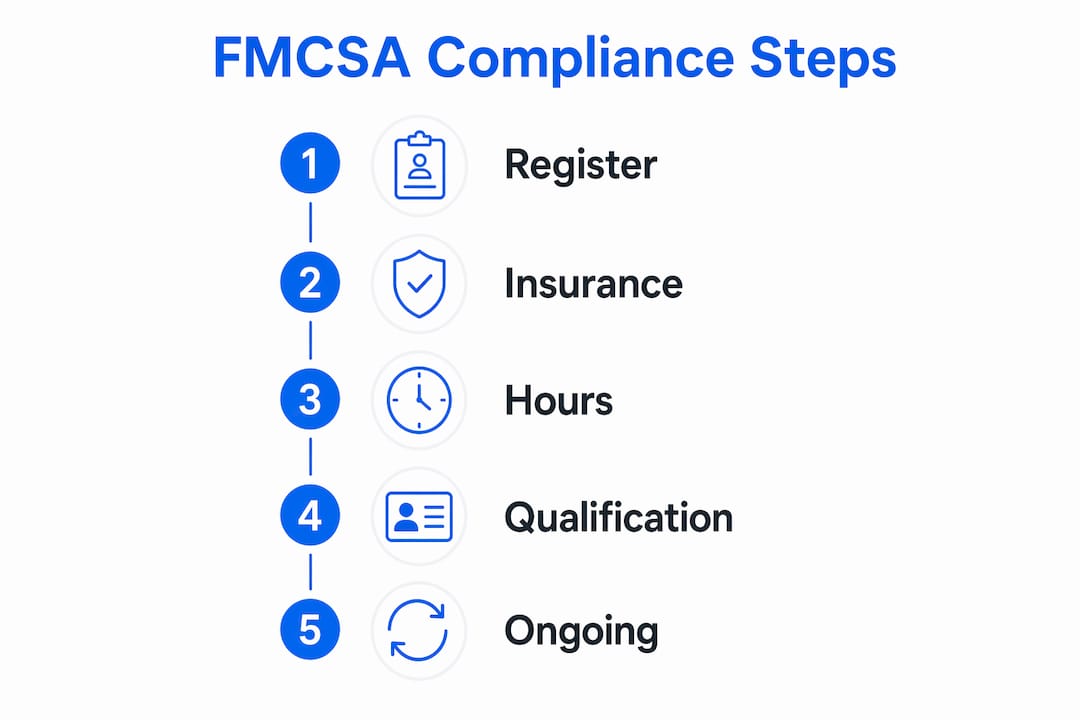
FMCSA compliance for solo trucking is defined as meeting all Federal Motor Carrier Safety Administration regulatory requirements for registration, insurance, hours of service, driver qualifications, and safety reporting to operate legally as an owner-operator. These requirements fall under 49 CFR and USDOT standards, and missing any one of them puts your operating authority at risk. This solo trucking FMCSA requirements guide covers every major compliance area in plain terms, so you know exactly what you need, when you need it, and how to stay ahead of audits. Whether you run one truck under your own authority or manage a small fleet, the rules apply to you the same way they apply to large carriers.
What are the registration and operating authority requirements for solo truckers?
Every solo trucker operating in interstate commerce must register for a USDOT number. Any commercial vehicle weighing 10,001 pounds or more that crosses state lines requires this registration. The USDOT number serves as your unique identifier during roadside inspections, audits, and safety monitoring. Without it, you cannot legally operate in interstate commerce.
Beyond the USDOT number, many solo operators also need an MC (Motor Carrier) number. The MC number is required if you transport regulated commodities for hire across state lines. If you haul your own goods, you may only need the USDOT number. Check the FMCSA registration portal to confirm which authority type applies to your operation.

Some states also require intrastate registration and a USDOT number even for operations that stay within state borders. These state-level requirements vary, so verify your home state's rules directly with your state DOT office.
Keeping your registration current is just as important as getting it in the first place. You must update your MCS-150 form every two years, or within 30 days of any change to your operation. Letting this lapse can trigger compliance flags in the FMCSA system.
Key registration requirements for solo truckers:
- Register for a USDOT number before operating in interstate commerce
- Obtain an MC number if hauling regulated freight for hire
- Check your state's intrastate USDOT registration rules
- Update your MCS-150 form every two years or after any operational change
- Verify your operating authority status is active before every load
Pro Tip: Set a calendar reminder 60 days before your MCS-150 renewal deadline. Late updates are one of the most common and easily avoidable compliance mistakes owner-operators make.
How do insurance requirements apply to solo trucking?
FMCSA sets minimum insurance thresholds based on your carrier type, operating authority, cargo, and vehicle type. General freight carriers typically must carry at least $750,000 in public liability coverage. Carriers hauling hazardous materials face higher minimums, sometimes reaching $5,000,000. These are federal floors, not ceilings, and your broker or shipper may require more.
When your insurance coverage changes, you need to update your FMCSA records. Requesting a change to your minimum insurance requirements requires submitting a ticket that includes your USDOT number, your MC number, and updated forms. FMCSA processes complete requests within 2 business days. Incomplete submissions delay the process, so accuracy matters before you submit.
The process for updating insurance requirements:
- Confirm your current operating authority type and cargo classification
- Gather your USDOT number and MC number
- Update your MCS-150 form to reflect any operational changes
- Submit your change request ticket to FMCSA with all required documents
- Verify your insurance filing is active in the FMCSA system after processing
Insurance requirements differ by entity type. Motor carriers, brokers, and freight forwarders each face different minimum coverage rules. Solo operators acting as both carrier and broker need to confirm which authority governs each load they accept.
Pro Tip: Before submitting any insurance change request, verify that your operating authority is active and your MCS-150 is current. Submitting with outdated forms is the single most common reason for processing delays.
What are the Hours of Service rules for solo truck drivers?
FMCSA Hours of Service regulations are found in 49 CFR 395 and apply to all commercial motor vehicle drivers, including solo operators. Revisions effective september 29, 2020 updated several provisions to give drivers more flexibility while maintaining safety standards. These rules are not optional, and violations show up directly in your safety score.
The core HOS limits for property-carrying solo drivers are:
- 11-hour driving limit: You may drive a maximum of 11 hours after 10 consecutive hours off duty
- 14-hour on-duty window: You cannot drive beyond the 14th consecutive hour after coming on duty
- 30-minute break requirement: A 30-minute break is required after 8 cumulative hours of driving without a break
- 60/70-hour limit: You may not drive after 60 on-duty hours in 7 consecutive days, or 70 hours in 8 consecutive days
- Sleeper berth flexibility: The 2020 revisions allow splitting sleeper berth time into a 7/3 split instead of requiring a full 8-hour period
The 2020 updates also introduced an adverse driving conditions exception and expanded the short-haul exemption. These provisions give solo operators real operational flexibility without reducing safety requirements.
HOS compliance is a behavioral safety program, not just paperwork. Fatigued driving is a leading cause of serious truck crashes, and the rules exist to keep you alert and on the road longer over your career. Treating your logbook as a safety tool rather than a bureaucratic burden changes how you manage your day.
Noncompliance with HOS rules carries direct consequences. Violations recorded during roadside inspections feed into your FMCSA Safety Measurement System score. A pattern of HOS violations can trigger a compliance review or full audit.
How must solo truckers handle driver qualification and the FMCSA Clearinghouse?
Driver qualification requirements are among the most detailed in the FMCSA rulebook. As a solo operator, you are both the employer and the driver. That dual role means you carry full responsibility for maintaining your own qualification file and querying yourself in the FMCSA Drug and Alcohol Clearinghouse.
Owner-operators must query the Clearinghouse at least once per year for themselves and any CDL drivers they employ. You must obtain driver consent before running a full query. Violations reported in the Clearinghouse prohibit you from performing safety-sensitive functions until a return-to-duty process is completed. There is no grace period.
Your driver qualification file must include:
- A valid commercial driver's license (CDL) copy
- A current medical examiner's certificate
- A completed application for employment
- Motor vehicle record (MVR) from each state where you held a license in the past three years
- Annual MVR review documentation
- Annual review of driving record
Medical certification is changing. States must implement National Registry II by june 23, 2025. In states that have not yet complied, medical examiners still issue paper certificates, and motor carriers must retain copies for up to 15 days after issuance. Check whether your state is compliant and adjust your documentation process accordingly.
Maintaining a complete driver qualification file is the fastest way for solo operators to reduce audit risk and prevent critical safety violations from appearing in the FMCSA Safety Measurement System.
The FMCSA SMS Driver Fitness BASIC directly ties incomplete qualification files to your safety score. Violations like missing medical cards or an invalid CDL affect investigation prioritization when they appear in a pattern across records. One missing document can cost you far more than the time it takes to file it correctly.
Pro Tip: Build a compliance calendar with annual Clearinghouse query dates, MVR review dates, and medical certificate expiration dates. Proactive query management prevents the kind of last-minute scramble that leads to unsafe operation suspensions.
Which ongoing practices keep solo trucking compliance on track?
Compliance is not a one-time event. It requires consistent record-keeping, regular self-audits, and prompt responses to any inspection findings. The FMCSA Safety Measurement System, known as SMS, scores your operation across seven BASICs: Unsafe Driving, HOS Compliance, Driver Fitness, Controlled Substances and Alcohol, Vehicle Maintenance, Hazardous Materials Compliance, and Crash Indicator. Your scores are publicly visible and affect your ability to win contracts.
Paperwork and driver file gaps can rapidly escalate to critical safety violations that affect audit prioritization. FMCSA investigators look for patterns, not isolated incidents. A single missing document is a flag. Repeated gaps are a pattern that triggers a compliance review.
The table below compares two broad approaches to managing solo trucking compliance records:
| Approach | Strengths | Weaknesses |
|---|---|---|
| Manual paper systems | Low upfront cost, no software needed | Easy to lose documents, hard to track expiration dates |
| Digital compliance platforms | Centralized records, expiration alerts, audit-ready files | Requires setup time and a monthly subscription |
Most owner-operators start with manual systems and switch to digital tools after their first close call with an audit. Digital platforms that track document expiration dates and flag missing records reduce the risk of compliance gaps significantly.
Best practices for ongoing FMCSA compliance:
- Review your SMS scores monthly at the FMCSA Safety and Fitness Electronic Records (SAFER) system
- Respond to roadside inspection violations within 15 days using the DataQs system if findings are incorrect
- Keep all driver qualification documents current and internally consistent
- Confirm your operating authority and insurance filings are active before accepting new loads
- Schedule a self-audit every six months to catch gaps before FMCSA does
Key Takeaways
Solo trucking FMCSA compliance requires active management of registration, insurance, hours of service, driver qualification files, and Clearinghouse queries to stay legally operational and audit-ready.
| Point | Details |
|---|---|
| USDOT registration is mandatory | Any interstate CMV over 10,001 lbs must have an active USDOT number and current MCS-150 on file. |
| Insurance must match your authority type | Minimum coverage thresholds vary by carrier type, cargo, and authority; submit change requests with complete documents. |
| HOS rules apply to every solo driver | 49 CFR 395 limits driving to 11 hours per shift; 2020 revisions added sleeper berth and adverse conditions flexibility. |
| Driver qualification files prevent audits | Complete, consistent files directly reduce your SMS Driver Fitness BASIC score and audit prioritization risk. |
| Clearinghouse queries are annual and required | Owner-operators must query themselves and any CDL drivers at least once per year with proper consent on file. |
The compliance mindset that actually protects solo operators
Most owner-operators I talk to treat FMCSA compliance as something they deal with when a problem shows up. That approach works until it doesn't. The operators who stay out of trouble are the ones who treat their qualification file like a financial record. They know exactly what is in it, when each document expires, and what needs updating.
The Clearinghouse requirement catches a lot of solo operators off guard because they do not realize they are both the employer and the driver under FMCSA rules. You have to query yourself. You have to maintain your own consent records. That is not intuitive, but it is the rule, and violations in the Clearinghouse shut you down immediately.
Hours of Service is the area where I see the most rationalization. Drivers convince themselves that pushing past the 14-hour window one time is not a big deal. But HOS violations compound. Two or three violations in a 24-month window can move your SMS score into the alert range, which puts you on FMCSA's radar for a compliance review.
The operators who run cleanest are the ones who set up systems before they need them. A compliance calendar costs nothing. A digital document tracker costs less per month than a single roadside violation fine. The math is obvious once you do it.
— Maks
Fleetguardlogistics: compliance management built for owner-operators
Running a solo operation means you wear every hat, including compliance officer. Fleetguardlogistics is an AI-powered compliance platform built specifically for solo operators and small trucking companies who need to stay audit-ready without hiring a dedicated compliance team.
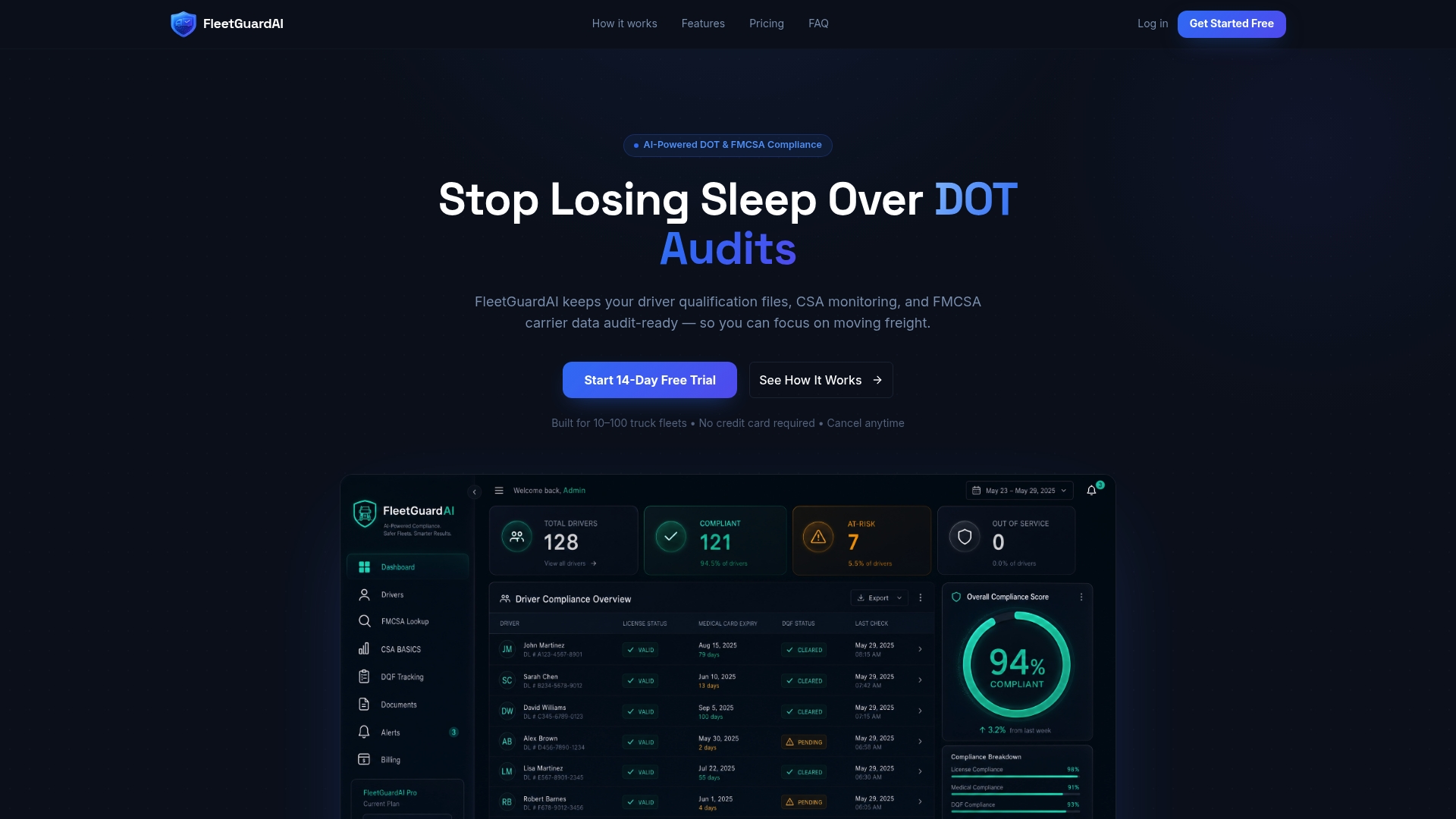
Fleetguardlogistics centralizes your driver qualification files, tracks document expiration dates, and sends proactive alerts before a medical card or CDL renewal becomes a problem. The platform monitors your FMCSA compliance status and flags gaps before they show up in an audit. You can try Fleetguardlogistics free for 14 days with no upfront cost. Solo operators who stay ahead of their compliance calendar do not lose sleep over surprise audits.
FAQ
What triggers an FMCSA audit for a solo trucker?
FMCSA prioritizes carriers for audits based on SMS scores, roadside inspection violations, and complaints. Repeated HOS violations, missing driver qualification documents, or inactive insurance filings are the most common triggers for solo operators.
Do I need an MC number as an owner-operator?
You need an MC number if you transport regulated commodities for hire in interstate commerce. If you haul your own goods exclusively, a USDOT number alone may be sufficient, but confirm with FMCSA based on your specific operation type.
How often must I query the FMCSA Clearinghouse for myself?
Owner-operators must query the Clearinghouse at least once per year. You must also obtain your own consent before running a full query on yourself.
What happens if my medical certificate expires?
An expired medical certificate is a disqualifying condition under FMCSA rules. It triggers a Driver Fitness violation in the SMS system and can result in an out-of-service order during a roadside inspection.
How do I update my insurance requirements with FMCSA?
Submit a ticket to FMCSA that includes your USDOT number, MC number, and an updated MCS-150 form. FMCSA processes complete requests within 2 business days when all required information is included.